A visual schedule for kids who can't read yet: how to make one that sticks
A visual schedule for kids is a short row of pictures, one for each step of a routine, so a child who can't read yet can see what comes next without asking you. Keep it to three to six steps, use photos of your child's own things, and put it at their eye level where the routine happens. Do it together for the first week, then swap pictures for words as they start reading.
What a picture schedule does that reminders can't
Most morning battles aren't about the task. They're about the reminder. "Teeth." "Shoes." "I said teeth." A list on the fridge means nothing to a child who can't read, so the only way they know what comes next is you telling them, again.
Pictures move that job from your voice to the wall. Your child looks, sees the toothbrush and goes, and you become the person who asks, "What's next on your chart?" They also get a bit of control over their own morning: they can see how much is left and when they're finished.
Start with one routine that happens every day in the same order. Morning is the usual pick, because it's the one with a deadline.
What goes on the chart: pictures and steps
A picture only works if your child knows what it means at a glance. That one test decides most of the choices.
Photos of their own things beat clip art
A photo of their own toothbrush, shoes and school bag needs no explaining. A cartoon toothbrush is one more thing to learn. Take the photos on a plain background in good light, one object each. Simple drawings work too, especially ones your child helped colour, as long as each looks different from the rest.
One action per picture
"Get dressed" is one step to an eight-year-old and four steps to a three-year-old: underwear, top, trousers, socks. If a step keeps stalling, it's usually two steps hiding in one picture. Split it.
Same picture, same word, every day
Keep each step's picture the same, with the word underneath in plain lower-case letters. The word helps later, when you fade the pictures. Avoid images that could mean two things: in a small drawing, a hairbrush looks a lot like a toothbrush.
How many steps, by age
Fewer than you think. A chart with ten pictures looks thorough and gets ignored. Start here and adjust: if your child loses track halfway, cut a step or split the routine in two.
| Age | Steps per routine | What to show | Your part |
|---|---|---|---|
| 3 | 2 to 3 | Large photos, no words needed | Do each step alongside them |
| 4 | 3 to 4 | Photos or clear drawings, word underneath | Point to the next picture, then step back |
| 5 to 6 | 4 to 6 | Picture and word, same size | Ask "What's next?" instead of telling |
| 7 to 8 | 6 to 8 | Word first, small picture | Check at the end, not at every step |
| 9 to 10 | As many as the routine needs | A written checklist | Let them write it and change it |
The ages are rough. Go by your child, not their birthday.
A sample morning routine chart and bedtime routine
Kai is 7 and reads simple words. Nora is 5 and doesn't read yet. They share a morning, but not a chart.
School-day morning
Nora's chart, five pictures:
- Toilet and wash hands
- Get dressed (clothes laid out the night before)
- Breakfast
- Brush teeth
- Shoes and coat on
Kai's chart, seven steps, words first with small pictures:
- Get dressed
- Make bed (pull the duvet up, that's all)
- Breakfast
- Brush teeth
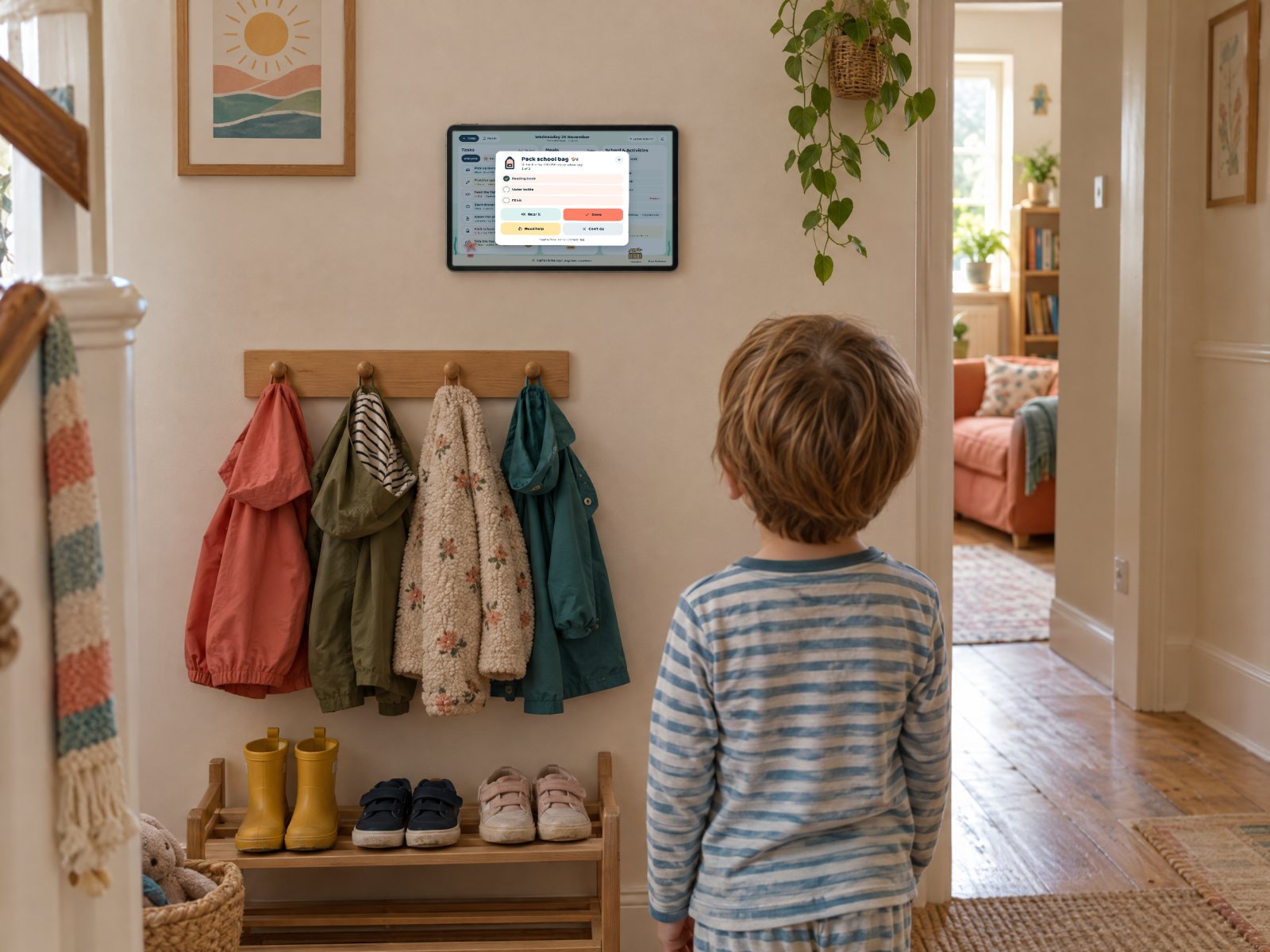
- Check school bag: reading book, water bottle, PE kit
- Shoes and coat on
- Bag by the door
Bedtime
- Tidy toys into one basket
- Bath or wash
- Pyjamas on
- Brush teeth
- Toilet
- Choose two books
- Lights out
That's Kai's version. Nora's starts at the bath, with tidying done before dinner. Notice the order: the step children enjoy, books, comes last, so the routine ends somewhere good. The one they resist, often teeth, sits in the middle.
Two habits make any morning routine chart easier. Do what you can the night before (clothes out, bag packed). And keep school days and weekends apart: a chart that says "school bag" on a Saturday teaches children the chart doesn't really mean it.
Where to put a visual schedule for kids
Put it where the routine happens, at your child's eye level: the morning chart in the kitchen or bedroom, the bedtime chart in the bathroom. One chart per routine, in one place.
- Their eye level, not yours. Roughly their shoulder height when standing.
- Make the steps movable. Laminated cards on sticky hook-and-loop dots, with a "done" pocket at the end, let your child finish each step by hand. Turning a card over works too.
- One row or colour per child. It ends arguments about whose card is whose.
- Clear space around it. A chart surrounded by school letters and magnets disappears.
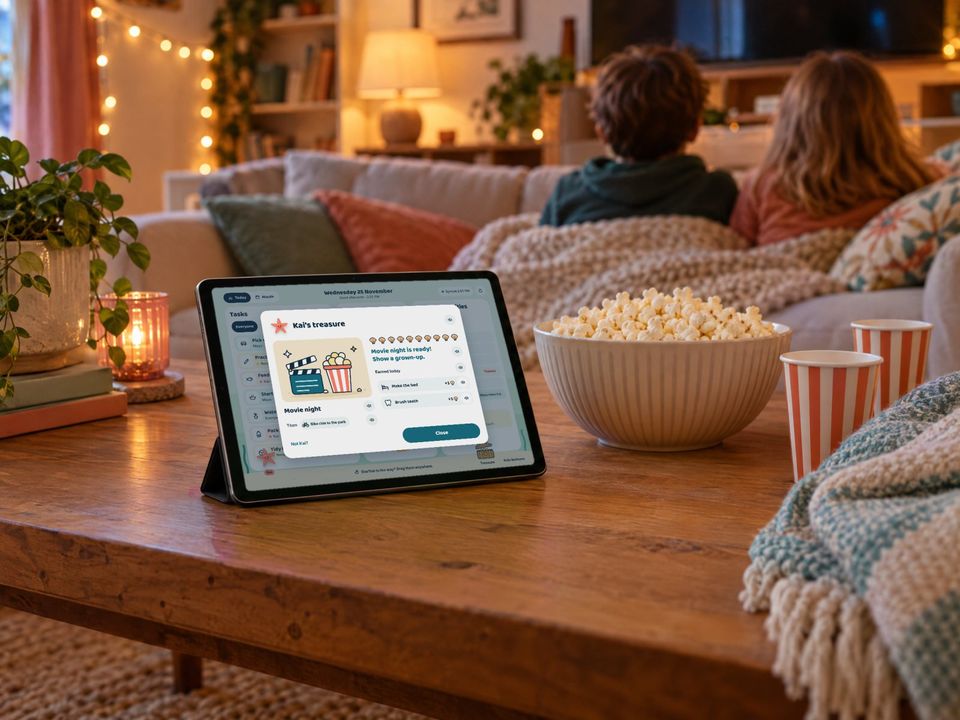
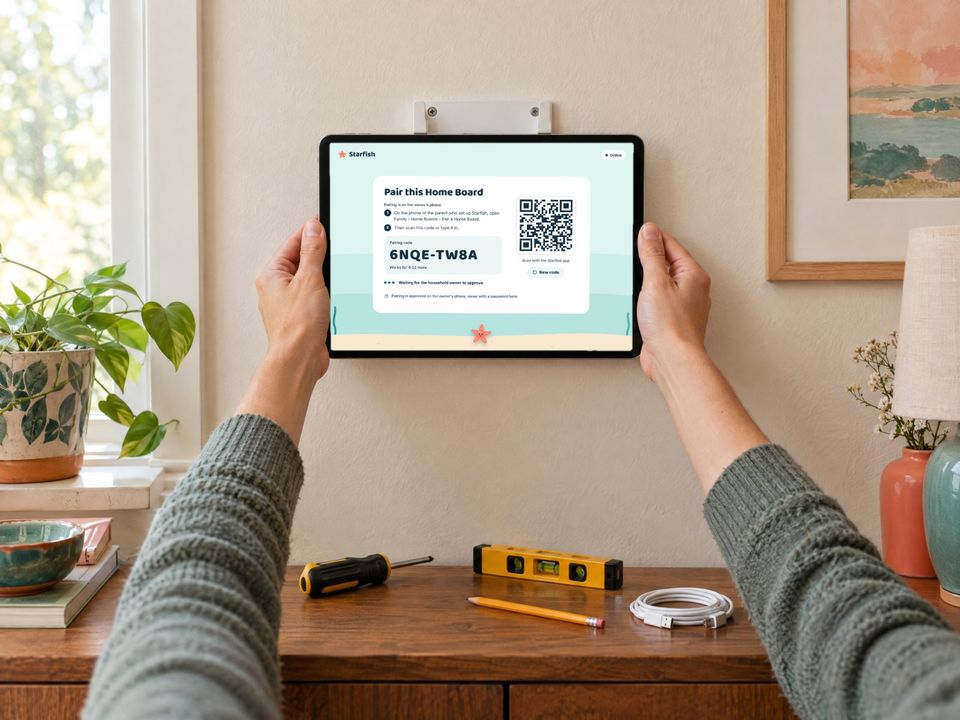
A paper routine chart for kids is cheap and works well, until routines change from week to week or the cards start going missing. Some families use a tablet on the wall instead. If you have one in a drawer, here's how to turn an old tablet into a family wall board.
Read-aloud and a parent's recorded voice
Sometimes a child needs to hear the step, not just see it. A photo of a coat could mean "put your coat on" or "hang your coat up". Hearing the words settles it.
With a paper chart, you are the voice. Say each step the same way every time ("Teeth, top and bottom") and point at the picture as you say it. Keep the phrase short enough for your child to say it back.
On a screen, read-aloud (text-to-speech) can speak every step on the device. A voice note in your own voice is better for steps that need a little explaining, such as "Shoes on, then wait by the door for me." If you record:
- Keep it to one instruction, under ten seconds.
- Use the words you say out loud, so you and the recording match.
- Record in the language your child hears most at home.
- Re-record when something changes, like a new school bag or a different route.
A routine chart for kids that reads itself aloud
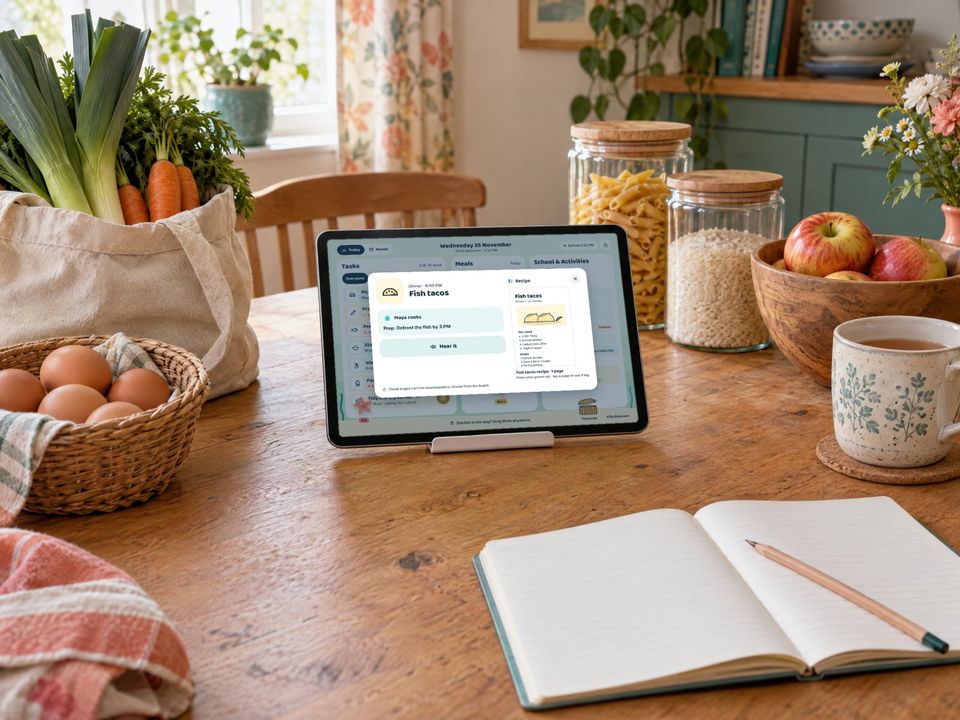
Starfish turns a tablet you already own into a wall board your children use themselves, while you plan from your own phone. Every task has a picture and a Hear it button that reads it aloud on the device, or plays a voice note you recorded instead. On your phone, Add several types a whole routine in one go, with built-in School morning and Bedtime lists, and a task can repeat every day or on school days only. A checklist inside a task breaks a big step down, such as a school bag with a reading book, water bottle and PE kit. When Nora picks her name, her list shows the next task on top and her starfish walks over to it. She answers Done, Need help or Can't do, and you get a notification for the last two.
Teach it, then fade it as they grow
The first week
A chart that appears overnight is easy to ignore. Try this instead:
- Make it with your child. Let them take some of the photos or choose the drawings.
- Walk through it once at a calm time, not at quarter to eight on a school day.
- For a few days, do each step with them, pointing to the picture first.
- Let them move the card or tick the step themselves. Finishing is the satisfying part.
- Praise what they did ("You did your teeth without me asking"), then stop pointing and ask, "What's next on your chart?"
Hold off on rewards in the first week: the routine is the habit you're building. If you add one later, reward charts that work covers how to keep it from turning into a bribe.
Fading support
The aim of a visual schedule is that one day your child doesn't need it. Move to the next stage only when the current one is easy.
- Stop prompting. Stay nearby, but let the chart do the reminding.
- Let words take over. Make the word bigger and the picture smaller.
- Combine steps. Toilet, dressed and teeth become one card: "Get ready".
- Hand over the editing. A seven- or eight-year-old can choose the order of their own morning, within your limits.
- Keep only the hard parts. Often the morning chart goes, but a packing checklist stays.
They're ready to move on when they do steps without looking, read the words before you do, or tell you the chart is "for babies". Bring the pictures back when life changes: a new school, a house move, a new baby. It's quicker to revive an old system than to teach a new one.
Questions parents ask
What age can a child start using a visual schedule?
You can start as soon as your child can point to a picture and tell you what it is, often around two or three. Begin with two or three steps and do them together. There's no upper age: older children move to a written checklist, and the pictures come back for anything new or tricky.
Should a visual schedule show times?
For children who can't read a clock, no. Order matters more than time: first this, then that. If there's one fixed deadline, such as leaving for school, end the row with a picture of a clock face showing that time. From about six or seven, times next to the steps make useful clock practice.
What if my child ignores the chart?
Check the chart before you blame the child. Too many steps, pictures they don't recognise, or a step that's really three will stall any routine. Cut it back to three steps, do it with them for a few days and let them move each card when it's done. Point instead of talking.
Is a picture schedule the same as a reward chart?
No. A visual schedule shows what to do and in what order. A reward chart tracks whether something got done and links it to a reward. You can use both, but let the routine settle first, so the steps feel like a normal part of the day rather than a deal.
If you have a spare tablet, try Starfish free and let the board read each step aloud.