Family meal planning: a whole week of dinners in about 20 minutes
Family meal planning gets quick once you stop starting from a blank page. Give each night a theme, fill it from a list of dinners your family already eats, cook double twice a week and try one new dish. With that frame, a week of dinners and the shopping list take about 20 minutes.
The 20-minute family meal planning method
Pick a regular slot, ideally the day before you shop, and have three things in front of you: the family calendar, your list of favourite dinners and a look in the fridge. The times below are a guide, not a stopwatch.
- Check the week (3 minutes). Note anything that changes dinner: swimming until 6, a parent away on Thursday, a party on Saturday. Busy nights get the quickest meal or leftovers.
- Use what you have (2 minutes). Half a bag of spinach and two chicken thighs can decide Monday for you. Check the freezer too.
- Fill the theme nights (5 minutes). With a theme, you choose between three or four dinners, not every recipe you have ever seen.
- Mark two cook-twice nights (2 minutes). Pick two dinners to make in double and decide where the second half goes.
- Add one new dish (2 minutes). Put it on your calmest night.
- Write the shopping list (5 minutes). Night by night, crossing off what is already in the cupboard.
- Name the cook and add prep notes (1 minute). Who cooks, and what has to happen earlier in the day.
The first week takes longer while you build your favourites list. After that, most of the plan is choosing from a list you already trust.
A sample week of theme nights
Themes are loose categories, not rules. They turn "what shall we eat?" into "which pasta?". Here is a sample weekly meal plan for Kai (7) and Nora (5), two working parents and a grandmother who cooks on Thursdays.
| Night | Theme | Dinner | Who cooks | Note |
|---|---|---|---|---|
| Sunday | Roast night | Roast chicken, potatoes and carrots | Dad | Roast extra chicken for Tuesday |
| Monday | Pasta night | Tomato and lentil pasta bake | Mum | Make two trays, one for Wednesday |
| Tuesday | Build-your-own night | Chicken wraps with bowls of fillings | Mum | Swimming until 6: chop the fillings in the morning |
| Wednesday | Leftovers night | Monday's pasta bake with cucumber sticks | Whoever is home first | Oven on at 5:30 PM |
| Thursday | Soup night | Vegetable soup and cheese toasties | Grandma | Recipe on the fridge door |
| Friday | Fish night | Baked fish, rice, peas or sweetcorn | Dad | Defrost the fish by 3 PM |
| Saturday | New dish night | Chickpea and spinach curry with flatbreads | Mum and Kai | Kai picked it from a cookbook |
Two dinners are cooked once and eaten twice, and the busiest night uses chicken that is already cooked. Other themes that work well: breakfast for dinner, traybake night, rice bowls, curry night and a "picnic plate" of bits from the fridge. Short of family dinner ideas for a theme? Ask everyone at the table for two dinners they would happily eat every week.
Three habits that make every week faster
Keep a list of rotating favourites
Write down 15 to 20 dinners that everyone eats without complaint and sort them by theme. Rotate through them so each comes round every two or three weeks, unless it is one the children ask for by name. When a new dish is a hit, it joins the list. When it gets groans two weeks running, it comes off.
Cook once, eat twice
- Double batch: make twice the quantity and eat the second half later in the week, or freeze it. Pasta bakes, soups, stews and curries suit this well.
- Planned leftovers: cook a base that becomes a different meal. Sunday's extra roast chicken becomes Tuesday's wraps, and a big pan of tomato sauce is pasta one night and the start of a vegetable curry later.
Label freezer tubs with the contents and date, and follow your local food safety advice on how long cooked food keeps.
One new dish a week, not seven
A whole week of new recipes means a long, unfamiliar shopping list and seven chances for a flop. One a week keeps dinner interesting and the risk small. Put it on a relaxed night and serve it with something familiar, such as bread or rice, so nobody leaves hungry if it does not land.
Picky eaters, allergies and getting kids involved
Let children choose, within limits
Children tend to take more interest in a dinner they helped choose. Offer choices with edges: Kai (7) picks Saturday's new dish from three recipes, and Nora (5) chooses peas or sweetcorn for Friday. Give them a kitchen job too, such as washing vegetables, stirring or setting the table. Our list of chores for kids by age has jobs that suit each age.
Picky eaters: one dinner, with something safe on the table
Cooking a separate meal for each child turns one dinner into three. Instead:
- Cook one dinner and include at least one food each child usually eats, such as rice, bread or cucumber.
- Serve the parts separately on build-your-own nights, so children choose what goes on their plate.
- Offer a new food in a small amount, without pressure or bargaining. If it is refused, it can come back in a few weeks without comment.
If you are worried about how little or how narrowly your child eats, talk to their doctor.
Allergies and diet notes
If anyone in the family has a food allergy, their doctor's advice comes first and nothing here replaces it. Planning helps in practical ways:
- Plan dinners that work for everyone, rather than cooking a second version.
- Read the label on every packet, every shop, because ingredients and allergy warnings can change.
- Write the diet note on the plan itself, such as "No nuts" or "Nora: no egg", so a grandparent or babysitter who cooks sees it.
The same habit covers food rules that are not allergies, such as halal or vegetarian: note it once on the plan and everyone who cooks works from the same page.
Shop from the plan, write prep notes, share the cooking
Turn the plan into a shopping list
Go through the week night by night and write down every ingredient. Cross off what you already have, then add your standing list of breakfast, lunch box and snack basics. Group it by aisle: fruit and vegetables, chilled, frozen, tins and dry goods, bread. One main shop and a small midweek top-up for bread, milk and fruit covers most weeks. Buying only for the plan also means fewer vegetables going soft at the back of the fridge.
Write prep notes where the cook will see them
A weeknight dinner often goes wrong at 3 PM, not 6 PM: the fish is still frozen or the slow cooker never went on. A short, timed prep note fixes that:
- "Defrost the fish by 3 PM."
- "Slow cooker on before the school run."
- "Soup is in the freezer, top drawer."
Decide who cooks which night
Put a name on every night, including leftovers night. Whoever gets home early takes the dinner that needs the oven, and whoever gets home late takes leftovers. If a grandparent or nanny cooks, give them the simplest repeatable dinners, the prep note and the recipe. Then post the plan where every cook will see it, on the fridge door or on an old tablet turned into a family wall calendar.
Keep breakfast, lunch boxes and snacks simple
Dinner is where the planning time should go. Everything else works better as a short, fixed rotation that lives on the standing shopping list.
- Breakfast: two or three school-day options, such as porridge, eggs on toast or cereal with fruit, and something slower at the weekend.
- Lunch boxes: a formula, not a menu. One main (sandwich, wrap, pasta salad or last night's leftovers), one fruit or vegetable, one snack and water. Children choose within it. Check your school's food rules, such as a nut-free policy.
- Snacks: a short list children pick from after school, such as fruit, yoghurt, crackers with cheese or carrot sticks, at a set time so it doesn't run into dinner.
Everyone knows what's for dinner without asking
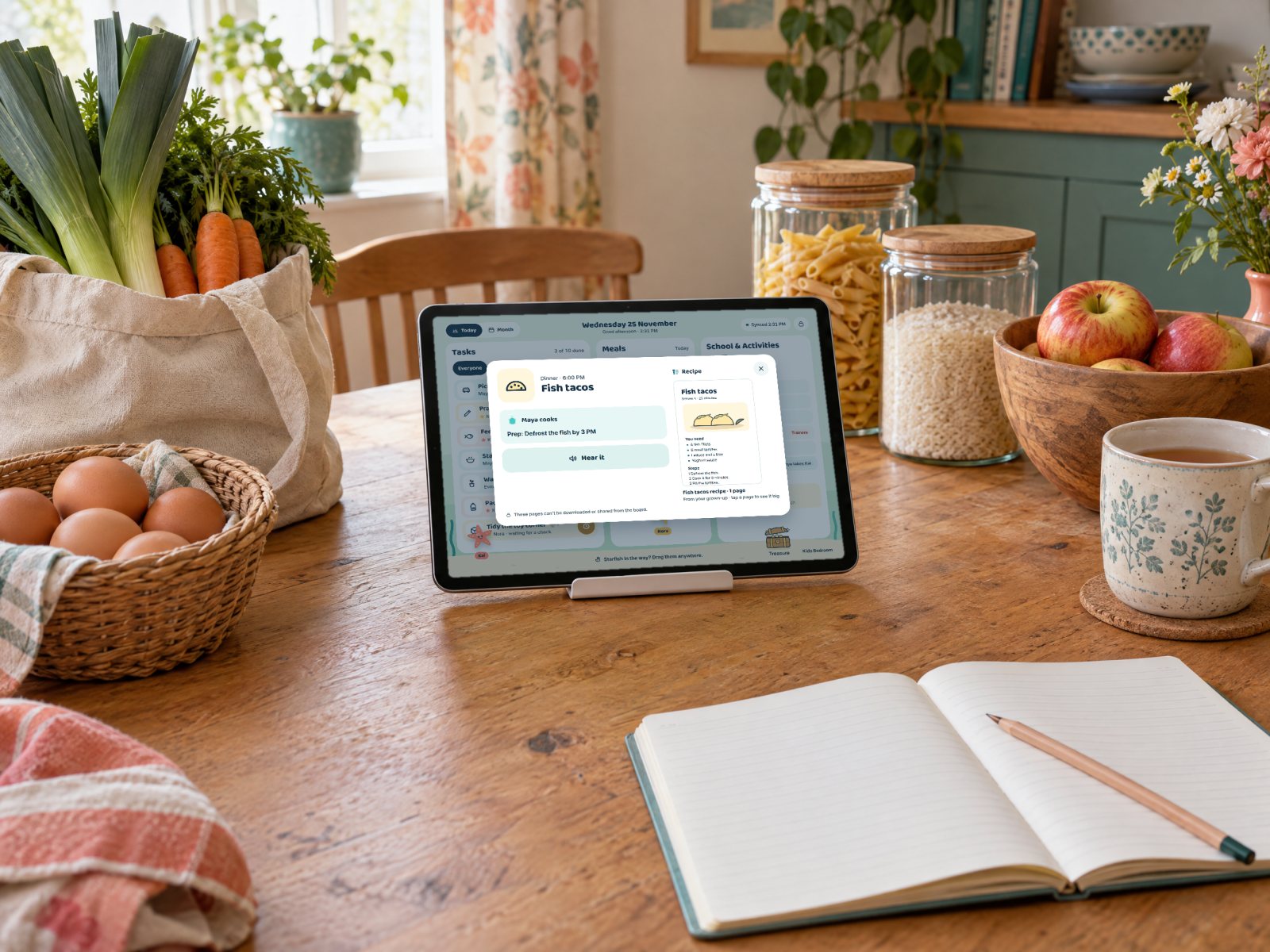
Whatever meal planner for families you use, paper or app, it works best where the whole household can see it. In Starfish, you plan breakfast, lunch, snack and dinner for each day from your phone, with who cooks, a prep note such as "defrost the fish by 3 PM" and diet notes like "No nuts". Favourites make next week quicker to fill, and a recipe can be attached for Grandma's night. The family tablet on the wall shows the next meal, so the children can see what's coming. Setting the table can be a daily task with a checklist: plates, cups, forks. With Premium, AI can draft the week's dinner ideas when you ask, and nothing is saved until you have checked them.
Questions parents ask
How do I start family meal planning?
Start small. Plan dinners only, for the next five nights, using meals your family already eats. Write the shopping list from that plan and shop once. The following week, add theme nights and start a favourites list. Once dinners feel easy, add a simple breakfast and lunch box rotation, rather than planning every meal from day one.
What are good theme nights for family dinners?
Choose themes broad enough to give several options each: pasta night, build-your-own (wraps, tacos or rice bowls), soup night, fish night, traybake night, breakfast for dinner, leftovers night and a new dish night. Give the busiest evenings the quickest themes, and swap themes when the family gets bored. The point is fewer decisions, not fixed rules.
How do I meal plan for a picky eater?
Cook one family dinner that includes at least one food the child usually eats, such as rice or bread. Serve the parts separately, let them help pick one dinner a week and offer new foods in small amounts without pressure. If you are worried about how much your child eats, speak to their doctor.
How do I make a weekly meal plan on a budget?
Check the fridge, freezer and cupboards first and build the week around what is already there. Shop from the list, not the shelves. Lean on low-cost staples such as lentils, eggs, rice, pasta and seasonal vegetables, cook double on the cheapest dinners and freeze the extra. A leftovers night each week means food you have paid for gets eaten.
Want the week's meals where everyone can see them? Try Starfish free.