How to make a reward chart for kids that works without bribes

A reward chart for kids works when it covers a few clear jobs, the reward is small and soon, and points once earned are never taken away. Choose experiences over things, set the first target so your child reaches it within days, and don't let a bad day wipe out a good week. Then phase the chart out once the jobs happen on their own.
How to set up a reward chart for kids that isn't a bribe
The difference between a reward and a bribe is timing. A bribe is offered in the moment, usually to stop something: "If you stop crying, you can have a treat." A reward is agreed in advance, for something your child does regularly, and it stays the same whether the day went well or not. Nothing on the chart is up for negotiation in the middle of a meltdown.
Setting one up is quick:
- Pick two to four jobs. Make them specific and visible: "put your shoes on the rack" rather than "be helpful". Choose things your child can already do, or nearly do. If you're not sure what suits their age, start with our list of chores for kids by age.
- Give every job a picture if your child can't read yet. Visual schedules for kids who can't read yet explains how.
- Agree the reward before you start. Offer three options you're happy with and let your child choose one.
- Set the points. One point for most jobs, two or three for a hard one.
- Put the chart where the jobs happen, at your child's eye level.
- Let your child add the point. For a four-year-old, putting the sticker on the sticker chart themselves is half the fun.
- Review it once a week, on a calm day, never straight after a bad one.
Choosing rewards for kids: experiences over things
The best rewards cost time rather than money. An experience means time with you, doesn't end up at the bottom of the toy box, and is easy to scale up or down. Toys are fine now and then, but if every target ends in a shop, each reward has to beat the last one.
Rewards that work well for children from 3 to 10:
- Choosing the film for family movie night
- Baking something together at the weekend
- An extra bedtime story
- A trip out with just one parent: the park, the library, a café
- Picking Saturday's dinner, and helping to cook it
- A picnic on the living room floor
- Staying up 20 minutes later on a Friday
- Having a friend over to play
A few to be careful with. Keep sweets off the list if you can, so food doesn't become a prize. Screen time can work, but as the only reward it turns every day into a negotiation over minutes. And skip rewards that are months away: a five-year-old can't work towards next summer.
How many points should a reward take?
Long enough to feel earned, short enough to stay real. If the target is too far away, a child works hard for three days, sees the finish line has barely moved, and gives up. Make the first reward easy to reach, so your child sees the chart keeps its promise, then stretch the next one a little.
Work out the target from a normal week, not a perfect one. Kai (7) has three one-point jobs a day and usually manages two or three, so his first reward sits at 15. Nora (5) has two jobs and a target of 8, which she can reach in four or five days even with a miss.
As a starting point by age:
| Age | Jobs on the chart | First reward within | Points to aim for |
|---|---|---|---|
| 3 to 4 | 1 to 2 | 1 to 2 days | 2 to 4 |
| 5 to 6 | 2 to 3 | 3 to 5 days | 8 to 12 |
| 7 to 8 | 3 to 4 | About a week | 15 to 25 |
| 9 to 10 | 3 to 5 | 1 to 2 weeks | 20 to 40 |
These are starting points, not rules. Give harder jobs, like tidying the whole bedroom, two or three points. Older children can save towards something bigger, as long as they see progress every day. And when you raise a target, say so: one that quietly creeps up feels like a trick.
Never take earned points away, even on bad days
Why points only go one way
A point on the chart records something your child did. Taking it away because they shouted at their sister later rewrites what happened, and teaches that effort isn't safe. A child who has lost points a few times has little reason to keep trying.
So keep it one-way. A missed job earns nothing. It never costs anything. Handle behaviour the way you normally would, separately, and leave the chart out of it.
What to do on a bad day
- Leave the box empty and move on. No lecture at the chart. Tomorrow starts clean, whatever happened today.
- Don't offer points to end a meltdown. That's the bribe sneaking back in, and children soon learn that meltdowns pay.
- Notice what did go right. "You still brushed your teeth, even though you were cross" means more on a hard day than another sticker.
When the whole week goes wrong
Look at the chart before you look at your child. Too many jobs, a distant reward, or a job that's vague ("be good") or too hard will stall any chart. Cut back to the two jobs that matter most and bring the next reward closer. Avoid perfect-week rewards that need every job done every day: they collapse on the first Tuesday.
If life is upside down with illness, a new baby, a house move or a holiday, pause the chart openly rather than letting it fail. "The chart's having a rest this week" keeps the points safe and the promise intact.
Reward charts for siblings
Every child gets their own jobs, their own target and their own reward. Fair doesn't mean the same: each child should be able to reach a reward in about the same time. Kai's 15 and Nora's 8 feel equal because both can get there within a week.
- Never compare. "Kai's nearly got his reward" sounds like encouragement to you and like a race to Nora.
- No rankings and no prize for the most points. A ranking makes one child the loser every week.
- Use a team goal for shared jobs. Tidying the living room together can count towards something the whole family enjoys, like a Saturday pancake breakfast.
- Give the youngest a chart too. A three-year-old who wants to join in can have one job and a tiny target.
When to phase a reward chart out
A reward chart is there to build habits, then step aside. Signs it's ready to go:
- The jobs get done without anyone mentioning the chart.
- Your child forgets to check it or to claim the reward.
- The same jobs have been done reliably for a few weeks.
Phase it out slowly rather than all at once:
- Graduate one job at a time. "You don't need points for teeth any more. You've got that." A new skill, like making their own breakfast, can take the empty spot.
- Stretch the targets so rewards come less often.
- Swap rewards for celebrations. A family dinner for the month they learned to pack their own school bag keeps the pride without the points.
- Keep the routine, drop the scoring. The jobs stay on a plain checklist. Only the points go.
The aim is a child who does the jobs, not a chart that runs forever.
A reward chart that never loses a point
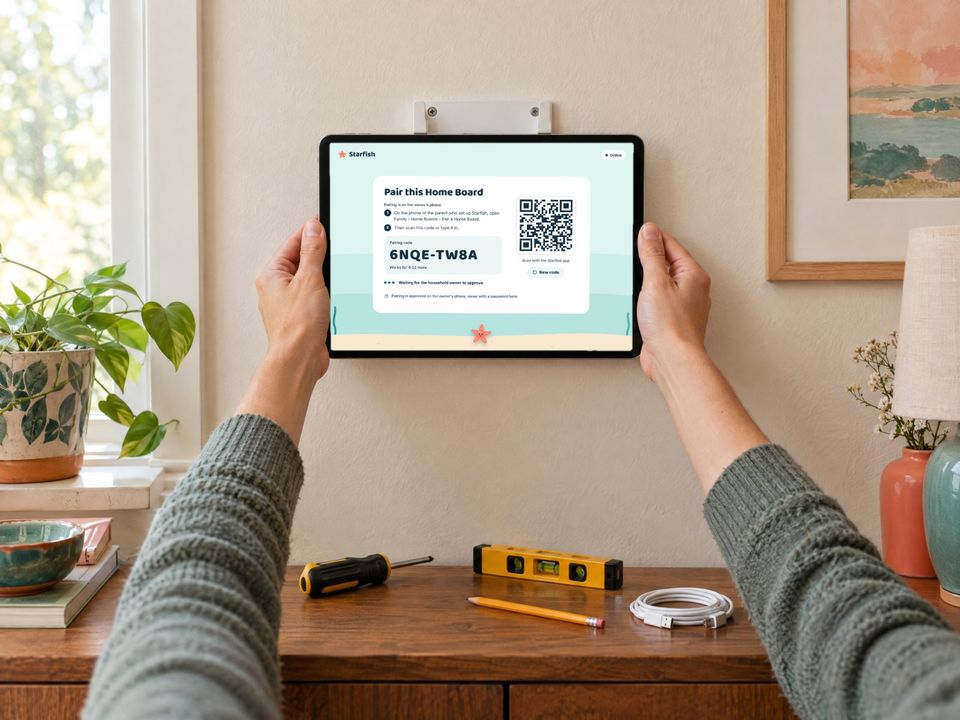
If paper charts keep falling off your fridge, Starfish turns a tablet you already own into a board the children use themselves. Points are called shells, and they stay off until you switch them on for a child. Each task can earn 0 to 3 shells towards a reward you set. You can line up to three rewards, filled in order, and the board shows progress in a treasure chest. A missed task never loses shells, and shells can never be bought. You mark a reward Given when the chest is full, or earlier if you choose. There are no streaks, badges or rankings, so siblings aren't measured against each other. Each child's starfish also lights up one arm at a time as their tasks get done.
Questions parents ask
What age should you start a reward chart?
Most children can use a simple reward chart from about three, as long as it's tiny: one or two jobs, a picture for each, and a reward within a day or two. A reward days away is hard for a young child to hold in mind. From about seven, most can work towards a reward a week or more away.
Should you take away stickers for bad behaviour?
No. Once a sticker is earned, leave it. Taking it back turns the chart into a punishment tool, and a child who keeps losing stickers has little reason to keep trying. Deal with behaviour using your usual consequences, separately. A missed job simply earns nothing that day. Keeping the chart one-way is what makes it worth working at.
How long should you use a reward chart?
As long as it's helping, and rarely forever. Plan on a few weeks to a few months for any set of jobs. When a job has happened without reminders for several weeks, take it off and celebrate. When the whole chart runs itself, stretch the targets, then retire it and keep the routine as a plain checklist.
Should chore rewards be money?
Money can work for older children if you keep two kinds of job apart. Everyday family jobs, like clearing your plate, are part of living together and earn points or nothing at all. Extra jobs you would otherwise do yourself, like washing the car, can earn money. Mixing the two invites "What will you pay me?" every time you ask for help.
What if my child loses interest in the reward chart?
Check the reward first: did they choose it, and is it close enough to feel real? Then check the jobs, because too many, too vague or too hard will stall any chart. Let them pick a fresh reward from a new shortlist, cut the jobs back to two and bring the next reward closer.
Want a reward chart that keeps count for you? Try Starfish free.